1763
Royal Proclamation of 1763 After the Seven Years' War, George III forbids colonial settlement west of the Appalachians. Many colonists ignore the line, and the resentment becomes one of the causes of the Revolution.
1765
Stamp Act Parliament passes the first direct tax on the colonies, requiring stamped paper for legal documents and newspapers. Colonial protests rally around "no taxation without representation", and the act is repealed in March 1766.
Parliament repealed the Stamp Act in 1766 but passed the Declaratory Act, insisting it could legislate for the colonies in all cases.
5 years · AI-written context
1770
Boston Massacre British soldiers fire into a crowd in Boston on 5 March 1770 and kill five colonists. John Adams defends the soldiers at trial, and most are acquitted.
1773
Boston Tea Party Sons of Liberty, disguised as Mohawk warriors, dump 340 or 342 chests of East India Company tea into Boston Harbor on 16 December 1773. Parliament answers with the Intolerable Acts in 1774.
1775
Battles of Lexington and Concord British troops march from Boston to seize colonial military supplies and clash with militia on 19 April 1775. These are the first major military actions of the war.
1776 – 1776
3 events, back to back 1777
Battles of Saratoga American forces defeat John Burgoyne's British army in two battles, and Burgoyne surrenders on 17 October 1777. The victory helps persuade France to back the Americans.
1778
Franco-American alliance Benjamin Franklin negotiates a treaty of amity and commerce and a treaty of alliance with France, signed on 6 February 1778. France begins supplying troops, ships and money.
1781
Articles of Confederation take effect The first national constitution takes effect on 1 March 1781, a loose league of states. Congress has no power to tax, regulate commerce or compel the states to comply.
1781
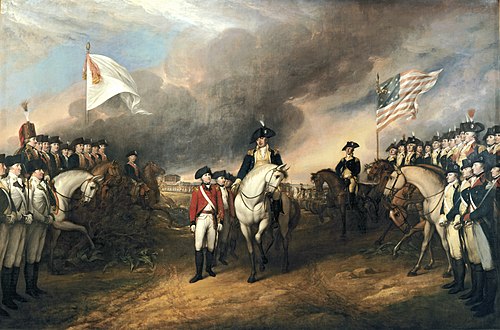
Siege of Yorktown A French and American army and a French fleet trap Cornwallis at Yorktown. About 8,000 British troops surrender on 19 October 1781, the last major land battle of the war.
1783
Treaty of Paris Britain recognises the United States as free, sovereign and independent, and cedes territory to the Mississippi. The treaty is signed on 3 September 1783, with Franklin, Adams and Jay among the American negotiators.
1786
Shays's Rebellion Indebted farmers in western Massachusetts shut down courts in an armed uprising. The weak federal government cannot fund troops to put it down, strengthening calls for reform.
1787
Constitutional Convention Delegates from twelve states meet in Philadelphia to revise the Articles but write a new Constitution. The Connecticut Compromise creates a House and Senate, and 39 delegates sign on 17 September 1787.
1789
Constitution takes effect After ratification by state conventions, the new government begins operating on 4 March 1789, replacing the Articles of Confederation. The Bill of Rights is ratified in 1791.