1947
Truman Doctrine On 12 March 1947 President Truman said the United States would support free peoples resisting subjugation. Congress approved $400 million in aid to Greece and Turkey in May.
1948
Berlin Blockade and Airlift After the Soviet Union cut ground access to West Berlin, US and British aircraft supplied the city by air from 26 June 1948 to 30 September 1949.
1949
First Soviet nuclear test On 29 August 1949 the Soviet Union tested RDS-1 at Semipalatinsk in Kazakhstan, ending the American nuclear monopoly. Its design drew heavily on the US Fat Man bomb, with help from espionage.
1950
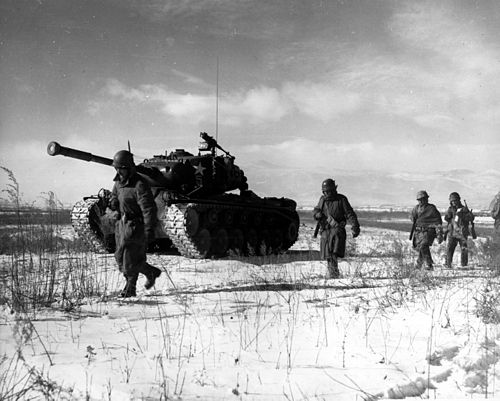
Korean War From 25 June 1950 to 27 July 1953 North Korea, backed by China and the Soviet Union, fought South Korea and UN forces led by the United States. It ended in an armistice and the Demilitarized Zone.
The Korean armistice came in 1953. Stalin's death that year and de-Stalinization raised hopes of reform in Eastern Europe.
6 years · AI-written context
1956
Hungarian Revolution A student and civilian uprising began on 23 October 1956 demanding Soviet withdrawal and free elections. The Soviet Union launched a full military response on 4 November, and nearly a quarter of a million Hungarians fled.
1961
Berlin Wall built Construction of the Berlin Wall began on 13 August 1961 to stop East Germans fleeing west. About 3.5 million had already left before it went up.
1962
Cuban Missile Crisis A thirteen-day confrontation from 16 to 28 October 1962 over Soviet missiles in Cuba, widely seen as the closest the Cold War came to nuclear war. It ended with a deal and the later creation of the Moscow-Washington hotline.
1964
Gulf of Tonkin incident Naval clashes off Vietnam in August 1964, one of which was later shown not to have occurred, led Congress to pass the Gulf of Tonkin Resolution on 10 August. It gave President Johnson broad authority for military action in Southeast Asia.
US combat troops reached Vietnam in 1965. China and the USSR, split since 1961, clashed on their border in 1969.
8 years · AI-written context
1972
SALT I signed Nixon and Brezhnev signed the first Strategic Arms Limitation agreement in Moscow on 26 May 1972. It froze the number of strategic ballistic missile launchers and limited anti-ballistic missile sites to one per country.
1975
Fall of Saigon North Vietnamese forces captured Saigon on 30 April 1975 after a final offensive, ending the Vietnam War. Nearly all American personnel were evacuated by helicopter.
1979
Soviet invasion of Afghanistan Soviet forces entered Afghanistan in December 1979 to support its communist government and stayed until 15 February 1989. Afghan mujahideen resisted with support from the US, Pakistan and others, and the war is often called the Soviet Union's Vietnam.
1980
Solidarity founded in Poland In August 1980 striking workers at the Lenin Shipyard in Gdansk founded Solidarity, the first independent trade union recognised in a Warsaw Pact country. Martial law in 1981 pushed it underground, and it won a breakthrough election on 4 June 1989.
1985
Gorbachev becomes Soviet leader Mikhail Gorbachev became General Secretary on 11 March 1985. His policies of glasnost (openness) and perestroika (restructuring) loosened Soviet society, and he held arms-reduction summits with Reagan.
1987
INF Treaty signed Reagan and Gorbachev signed the Intermediate-Range Nuclear Forces Treaty on 8 December 1987. It banned ground-launched missiles with ranges of 500 to 5,500 km, and 2,692 weapons were destroyed by 1991.
1989
Berlin Wall opens The Berlin Wall began to be demolished from 9 November 1989 after the year's revolutions across the Eastern Bloc. Germany reunified on 3 October 1990.
1991
Dissolution of the Soviet Union After a failed hardliner coup in August 1991, leaders of Russia, Belarus and Ukraine declared the Soviet Union ended on 8 December. Gorbachev resigned on 25 December and the Soviet Union was formally dissolved on 26 December.