1498
Vasco da Gama reaches Calicut The Portuguese fleet under Vasco da Gama anchored near Kappad, close to Calicut, making him the first European to reach India by sea around Africa. Relations with the Zamorin soured over customs and gifts.
1502
Vasco da Gama's armed return to Calicut On his second voyage da Gama commanded a heavily armed squadron, attacked Arab shipping and used force against Calicut to secure trading terms.
1505
Portuguese State of India established The Estado da India was formally set up with Francisco de Almeida as first viceroy, based at Fort Manuel in Cochin.
1510
Portuguese conquest of Goa After losing the city earlier in the year, Afonso de Albuquerque retook Goa from the Bijapur Sultanate on St Catherine's Day with the help of Timoji; Goa became the capital of Portuguese India for over four centuries.
1526
First Battle of Panipat Babur's invading army, using field artillery and the tulughma formation, defeated and killed Sultan Ibrahim Lodi, ending the Lodi dynasty and founding the Mughal Empire.
1527
Battle of Khanwa Babur defeated the Rajput confederacy of Rana Sanga of Mewar, crushing the strongest resistance to Mughal rule and consolidating his hold on the Delhi–Agra region.
1556
Second Battle of Panipat The Mughals under the young Akbar defeated Hemu (Hemchandra Vikramaditya), restoring Mughal control of Delhi after the Sur interlude.
1565
Battle of Talikota The allied Deccan sultanates of Bijapur, Bidar, Ahmadnagar and Golconda defeated Vijayanagara; its capital was sacked and never reoccupied.
1600
English East India Company chartered Queen Elizabeth I granted a royal charter to the Governor and Company of Merchants of London trading into the East Indies, with a 15-year monopoly on trade east of the Cape of Good Hope.
1602
Dutch East India Company founded The VOC was formed two years after the English company and soon set up its first Indian factory at Masulipatnam in 1605.
1610 – 1615
4 events, back to back 1610 Dutch build Fort Geldria at Pulicat
1612 Battle of Swally
1613 English factory at Surat sanctioned
1615 Sir Thomas Roe's embassy to Jahangir
1620
Danes build Fort Dansborg at Tranquebar The Danish East India Company established its main Indian settlement at Tranquebar (Tharangambadi) by treaty; it was sold to the British in 1845.
1639
English acquire the site of Madras Francis Day obtained the site of Madras from the ruler of Chandragiri; Fort St George became the English headquarters on the east coast.
1661
Bombay passes from Portugal to England Bombay was given to Charles II as part of Catherine of Braganza's dowry, and in 1668 the Crown handed it to the East India Company for a nominal annual rent.
1664
French East India Company founded Jean-Baptiste Colbert founded the Compagnie des Indes Orientales, the last major European company to enter the India trade.
1674
French settle Pondicherry François Martin established a French trading centre at Pondicherry on land obtained under the Bijapur Sultanate; it became the capital of French India in 1701.
1690
Job Charnock's settlement grows into Calcutta The English established a factory at Sutanuti under Job Charnock and in 1698 gained zamindari rights over Sutanuti, Kalikata and Gobindapur, the nucleus of Calcutta.
1707
Death of Aurangzeb The death of the last powerful Mughal emperor began a period of rapid Mughal decline, opening space for regional powers and European companies.
1739
Battle of Karnal and sack of Delhi Nader Shah of Iran routed Mughal emperor Muhammad Shah within hours, occupied and sacked Delhi, and carried off the Peacock Throne and the Koh-i-Noor.
1741
Battle of Colachel Marthanda Varma's Travancore defeated the Dutch East India Company, ending Dutch power on the Malabar Coast; one of the earliest defeats of a European power by an Indian state.
1757
Battle of Plassey Robert Clive's Company force defeated Nawab Siraj-ud-Daulah after Mir Jafar, the Nawab's commander, held back his troops; Mir Jafar was installed as a puppet nawab.
1760
Battle of Wandiwash British forces under Eyre Coote decisively defeated the French under the Comte de Lally in the Third Carnatic War; Pondicherry fell soon after and the 1763 Treaty of Paris returned French posts for trade only.
1761
Third Battle of Panipat Ahmad Shah Durrani's Afghan army defeated the Maratha Empire, checking Maratha expansion in the north and leaving a power vacuum the British would exploit.
1764
Battle of Buxar Hector Munro's Company army defeated the combined forces of Mir Qasim, Shuja-ud-Daula of Awadh and Mughal emperor Shah Alam II.
1765
Treaty of Allahabad Shah Alam II granted the East India Company the diwani of Bengal, Bihar and Orissa, the right to collect their revenue, turning the Company into a territorial power.
1799
Fall of Seringapatam and death of Tipu Sultan Company forces with the Nizam of Hyderabad stormed Tipu Sultan's capital, ending the Fourth Anglo-Mysore War; Tipu was killed in the fighting.
1818
Peshwa Baji Rao II surrenders After defeats in the Third Anglo-Maratha War, the last Peshwa surrendered to John Malcolm near Mhow and was pensioned off to Bithur, ending the Maratha confederacy as a rival power.
1845
Denmark sells Tranquebar to Britain Fort Dansborg and Tranquebar were sold to the British, part of the Danes' withdrawal from India.
1848
Dalhousie's governor-generalship Lord Dalhousie expanded British territory through war, the Doctrine of Lapse and annexation on grounds of misgovernance.
1849
Annexation of Punjab After the Second Anglo-Sikh War, Dalhousie annexed the Sikh kingdom; young Maharaja Duleep Singh was deposed and the Koh-i-Noor taken from the Lahore treasury.
1856 – 1858
3 events, back to back 1877
Victoria proclaimed Empress of India At the first Delhi Durbar organised by Viceroy Lord Lytton, Queen Victoria was proclaimed Kaiser-i-Hind, following the Royal Titles Act of 1876.
1885
Indian National Congress founded The Congress held its first session at Gokuldas Tejpal School in Bombay with 72 delegates, W. C. Bonnerjee presiding; it became the main vehicle of the independence movement.
1905
Partition of Bengal Lord Curzon's division of Bengal took effect, provoking the Swadeshi and boycott movements.
1906
All-India Muslim League founded The Muslim League was founded at Dacca; it would later lead the demand for Pakistan.
1919
Jallianwala Bagh massacre Troops under Brigadier-General Reginald Dyer fired on an unarmed crowd gathered in Amritsar amid protests against the Rowlatt Act, killing hundreds.
1920
Non-cooperation movement Gandhi launched a nationwide campaign of non-cooperation with British rule; he called it off in February 1922 after the violence at Chauri Chaura.
1930
Purna Swaraj Day Following the Congress's Lahore resolution for complete independence under Jawaharlal Nehru, 26 January 1930 was observed as Independence Day; the date was later chosen for the Republic.
1930
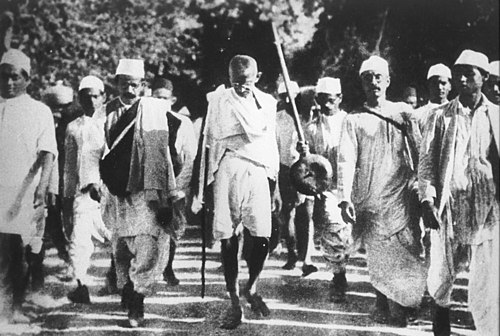
Salt March Gandhi led followers from Sabarmati to Dandi to make salt in defiance of the salt tax, launching the Civil Disobedience Movement.
1942
Quit India Movement The Congress demanded an immediate end to British rule; Gandhi and the leadership were arrested and the movement was suppressed, but it showed Britain that India was becoming ungovernable.
1947 – 1950
6 events, back to back 1947 Indian Independence Act 1947
1947 Independence and Partition
1947 Drafting Committee of the Constitution appointed
1948 Annexation of Hyderabad
1949 Constitution of India adopted
1950 India becomes a republic
1954
French India transferred de facto France handed over Pondicherry and its other Indian establishments to India, ending the French presence (after Chandernagore had already joined India).
1961
Annexation of Goa by India Indian forces ended roughly 450 years of Portuguese rule in Goa, the last European colonial enclave on the subcontinent.