1937
Nanjing Massacre After the Second Sino-Japanese War began in July 1937, Japanese forces took Nanjing in December and committed mass killings and rapes of civilians and prisoners. Modern estimates of the dead run from about 100,000 to 200,000.
1938
Munich Agreement On 30 September 1938 Germany, Britain, France and Italy agreed that Germany could annex the Sudetenland from Czechoslovakia. It is now seen as a failed example of appeasement.
1938
Kristallnacht On 9 and 10 November 1938 Nazi paramilitaries and civilians attacked Jewish shops, homes and synagogues across Germany, Austria and the Sudetenland. About 30,000 Jewish men were sent to concentration camps.
1939
Molotov-Ribbentrop Pact Germany and the Soviet Union signed a non-aggression treaty in Moscow on 23 August 1939. A secret protocol divided Eastern Europe into spheres of influence.
1939
Invasion of Poland Germany invaded Poland on 1 September 1939 and Britain and France declared war on 3 September. The Soviet Union invaded from the east on 17 September.
1940
Battle of Britain From 10 July to 31 October 1940 the RAF defended the United Kingdom against the Luftwaffe. Germany failed to gain air superiority, and the invasion plan, Operation Sea Lion, did not go ahead.
1941
Operation Barbarossa On 22 June 1941 Germany and its allies invaded the Soviet Union along a front of about 2,900 km. The advance stalled outside Moscow in December.
1941
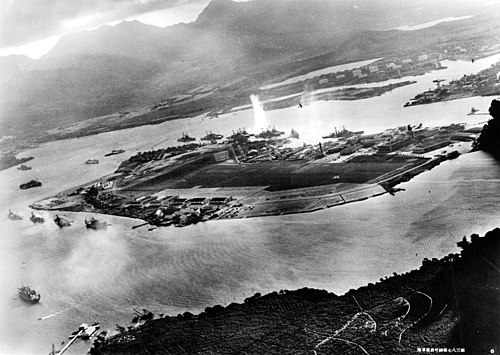
Attack on Pearl Harbor On 7 December 1941 Japan launched a surprise air raid on the US Pacific Fleet in Hawaii, killing 2,403 people. The United States declared war on Japan the next day.
1942
Wannsee Conference On 20 January 1942 Reinhard Heydrich chaired a meeting of 15 officials in a Berlin suburb to coordinate government departments in carrying out the Final Solution, the murder of Europe's Jews.
1942
Battle of Midway On 4 to 7 June 1942 US forces sank four Japanese fleet carriers while losing the carrier Yorktown, a turning point in the Pacific War.
1942
Battle of Stalingrad From July 1942 to 2 February 1943 German and Soviet forces fought for the city. The German 6th Army under Friedrich Paulus surrendered, the first German field army to do so.
1943
Warsaw Ghetto Uprising From 19 April to 16 May 1943 several hundred Jewish fighters resisted the liquidation of the Warsaw Ghetto. German forces crushed the revolt and destroyed the ghetto.
After Kursk in July 1943, Germany never regained the initiative in the East. The Western Allies landed in Normandy in June 1944.
1 year · AI-written context
1944
D-Day landings in Normandy On 6 June 1944 about 156,000 Allied troops landed on five Normandy beaches in Operation Neptune, the amphibious phase of Operation Overlord.
1945
Liberation of Auschwitz Soviet forces liberated Auschwitz on 27 January 1945. At least 1.1 million people, most of them Jews, had been killed at the camp complex, which opened in May 1940.
1945
Germany surrenders (VE Day) After Hitler died on 30 April 1945 and Berlin fell on 2 May, Germany signed surrender at Reims on 7 May and in Berlin on 8 May, which is celebrated as Victory in Europe Day.
1945
Atomic bombings and Japan's surrender The United States bombed Hiroshima on 6 August 1945 and Nagasaki on 9 August. Japan announced its surrender on 15 August and signed the formal instrument on 2 September.